Freshly milled flour can improve flavor and give home bakers more control over ingredients, but a full-size grain mill is not practical for every countertop. The best grain mills for small kitchens balance milling performance with a compact footprint, manageable storage, and straightforward cleanup.
This roundup compares 10 options, from high-speed electric grinders and stand-mixer attachments to hand-crank mills and grain flakers. Consider your batch size, available storage, noise tolerance, and preferred level of hands-on work before choosing.
Best 10 Grain Mills for Small Kitchens Picks for 2026
Best Compact Electric Mill

- 1,200-watt motor for hard grains
- Fine bread flour from impact milling heads
- Nesting parts with 8-cup hopper
Best For: Frequent bread bakers needing compact storage
Best Stand-Mixer Attachment
KitchenAid All-Metal Grain Mill

- Attaches to KitchenAid stand mixers
- Nine adjustable grind settings
- Removable, brush-clean design
Best For: KitchenAid owners conserving counter space
Best Multi-Purpose Mini Grinder
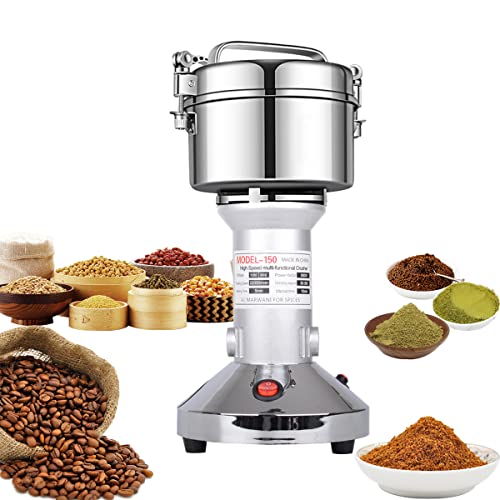
- Compact 150g small-batch capacity
- 900-watt motor with triple blades
- Handles dry grains, spices, and herbs
Best For: Small batches and varied dry ingredients
Best Manual Mill
Victoria Cast Iron High Hopper

- Hand-crank operation needs no electricity
- Adjustable coarseness for varied ingredients
- Clamps to 1/2–2-inch tables
Best For: Manual coarse milling and off-grid kitchens
Compact Electric Power
150g Stainless Steel Grain Grinder

- 1000-watt motor with fast 25,000-rpm operation
- Handles dry grains, spices, coffee, and herbs
- Automatic overload shutoff and included spare parts
Best For: Small-batch grinding in compact kitchens
Hand-Crank Classic

- Adjustable coarse-to-fine grinding
- Durable cast iron construction
- Countertop clamp and complete hand-crank kit included
Best For: Hands-on home grinding without electricity
Flour and Flakes
Marcato Marga Mulino Grain Mill

- Manual mill and flaker in one appliance
- Three adjustable texture settings
- Handles both soft and hard grains
Best For: Home bakers making fresh flour and cereal flakes
Compact High-Speed Grinder

- Compact footprint for small kitchens
- 850W, 28,000-RPM dry grinding
- Safety and overload protection
Best For: Small batches of dry grains, spices, and coffee
Stand Mixer Flour Mill
KitchenAid Attachment with 9 Settings

- Uses an existing KitchenAid mixer
- Nine adjustable grind levels
- Tool-free installation and detachable chamber
Best For: KitchenAid owners with limited counter space
Large-Batch Swing Mill

- Large 800g grinding cup
- 2,100W motor with 28,000 RPM
- Timed controls and adjustable fineness
Best For: Larger dry-grinding batches and frequent use
Best Compact Electric Mill – NutriMill Impact Compact
For shoppers comparing grain mills for small kitchens, the NutriMill Impact Compact offers electric milling power while keeping storage practical. Its nesting parts, 1,200-watt motor, and impact milling heads are suited to producing fine flour from hard grains such as wheat.
Best For: Frequent bread bakers who want an electric mill with larger batch capacity and organized storage.
Pros:
- 1,200-watt motor handles hard grains such as wheat.
- Impact milling heads are designed for fine-textured bread flour.
- 8-cup hopper and 12-cup flour canister support larger batches.
- Parts nest together, and the cyclone air filtration system helps maintain airflow.
Cons:
- Its larger hopper and canister capacity may be more than occasional users need.
- The supplied information does not specify a noise rating or footprint.
This is a strong fit when compact storage matters but you still want the speed and capacity of an electric bread-flour mill.
Best Stand-Mixer Attachment – KitchenAid All-Metal Grain Mill
Among grain mills for small kitchens, this KitchenAid attachment saves counter space by using a stand mixer you already own. Its nine grind settings let you move from coarse to fine textures when processing dry, low-moisture grains such as wheat, oats, corn, millet, and other suitable ingredients.
Best For: KitchenAid owners who want adjustable flour textures without storing a separate electric mill.
Pros:
- All-metal die-cast aluminum construction.
- Nine adjustable settings provide coarse-to-fine control.
- Removable design and included cleaning tool simplify dry brushing.
- Suitable for dry, low-moisture, low-oil grains including wheat, oats, and corn.
Cons:
- It is intended for KitchenAid stand mixers rather than standalone use.
- Not suitable for high-oil ingredients such as nuts or sesame seeds.
- Extended batches require 30–45-minute cooling breaks for the mixer.
For a small kitchen already equipped with a KitchenAid mixer, this attachment offers useful grind adjustment with less dedicated equipment, provided you follow its grain and cooling limits.
Best Multi-Purpose Mini Grinder – 150g High-Speed Electric Mill
If you need grain mills for small kitchens that can also handle pantry ingredients, this compact 900-watt grinder processes dry grains, spices, herbs, and other dry foods. Its 150-gram capacity and short operating cycles make it better suited to small batches than continuous flour production.
Best For: Small-batch users who want one compact machine for dry grains, spices, herbs, and similar ingredients.
Pros:
- Compact 150-gram capacity suits small quantities.
- 900-watt motor and triple-blade design support fast dry grinding.
- Can process grains, spices, herbs, coffee beans, and other listed dry foods.
- Overload shutoff and reset button add a stated safety feature.
Cons:
- Grinding sessions should be limited to three minutes, followed by a 5–10-minute rest.
- Wet, moist, or oily ingredients cannot be ground.
- The grinding container should not be washed directly with water.
This model is a flexible small-batch grinder rather than a dedicated high-volume flour mill. Its operating pauses and dry-ingredient restrictions should guide expectations.
Best Manual Mill – Victoria Cast Iron High Hopper
For grain mills for small kitchens without another appliance to store, the Victoria manual mill offers a hand-crank alternative. Its cast iron body clamps to tables 1/2 to 2 inches thick, while the adjustable screw changes coarseness for grains and a broad range of other foods.
Best For: Users who prefer manual milling for corn, coarse grains, coffee, brewing ingredients, and other listed foods.
Pros:
- Manual operation requires no electricity or motor storage.
- Heavy-duty cast iron construction with a high hopper.
- Adjustable screw supports different coarseness levels.
- Table clamp and non-slip rubber protector help stabilize the mill.
Cons:
- It cannot produce a superfine texture or fine whole-wheat powder.
- Manual cranking is less convenient for large flour batches.
- It requires a compatible 1/2–2-inch-thick table or work surface.
This is a practical choice for off-grid use, occasional coarse milling, or cooks who value a traditional hand-crank design more than superfine flour.
Compact Electric Power – 150g Stainless Steel Grain Grinder
For shoppers comparing grain mills for small kitchens, this compact electric grinder offers fast, multipurpose processing in a stainless steel body. Its 150g capacity and 1000-watt motor suit small batches of dry grains, coffee, spices, herbs, and other dehydrated ingredients.
Best For: Small-batch grinding when speed and versatility matter more than continuous operation.
Pros:
- 1000-watt motor and 25,000-rpm speed can produce textures from 50 to 300 mesh.
- 304 stainless steel construction with three-layer blades.
- Includes spare blades, carbon brushes, a cleaning brush, and a one-year warranty.
- Automatic overload shutoff adds a useful safety feature.
Cons:
- The 150g capacity is limited for larger batches.
- Recommended operation is limited to three minutes, followed by a five- to 10-minute rest.
- It is intended for dry ingredients and cannot be washed directly with water.
This is a practical choice for a small kitchen that needs quick, occasional grinding. Its compact footprint and broad ingredient range are appealing, but batch size and cooldown requirements make it less suitable for high-volume flour production.
Hand-Crank Classic – Corona Manual Grain Mill
This Corona manual mill is a strong option for grain mills for small kitchens when you prefer hands-on control and no electricity. Its cast iron construction, adjustable grind, and countertop clamp make it suitable for preparing corn, wheat, rice, coffee, spices, and other ingredients.
Best For: Home cooks who want a durable manual mill for masa, flour, cracked grains, and everyday kitchen grinding.
Pros:
- Adjustable settings support coarse-to-fine textures.
- Heavy-duty cast iron body with food-safe tin plating.
- Includes the hopper, grinding plates, clamp, handle, mounting hardware, and stabilizing pad.
- Clamp fits countertops up to 1.45 inches thick for stable use.
Cons:
- Manual operation requires more effort than an electric mill.
- At 4.11 kg, it is relatively heavy to move or store.
- The countertop clamp may not suit surfaces thicker than 1.45 inches.
The Corona favors durability and control over convenience. It takes more physical effort, but its adjustable grind and broad ingredient compatibility make it a versatile fit for cooks who do not mind hand-cranking.
Flour and Flakes – Marcato Marga Mulino Grain Mill
For grain mills for small kitchens that need more than flour, the Marcato Marga Mulino combines milling and flaking in a compact manual design. Its adjustable settings handle soft and hard grains, giving home bakers options for fresh flour, cereal flakes, and malt.
Best For: Home bakers who want adjustable flour and flake preparation from a compact, manually operated mill.
Pros:
- Produces flour, cereal flakes, and malt.
- Adjustable coarse, medium, and fine settings.
- Works with soft grains such as oats and barley as well as hard grains such as rice and buckwheat.
- Chrome-steel construction and food-safe anodized aluminum rollers support consistent milling.
Cons:
- Manual operation may be slower and more labor-intensive than electric grinding.
- Its 2.82 kg weight is heavier than some compact countertop appliances.
- The Pastadrive motor is compatible, but the mill itself is manual.
The Marga Mulino stands out for versatility in a relatively small 6.69-by-5.12-by-8.66-inch form. Choose it when making flakes is as important as producing flour; choose an electric model instead if speed is the priority.
Compact High-Speed Grinder – 150g Electric Dry Mill
For shoppers comparing grain mills for small kitchens, this upright electric grinder offers a relatively compact footprint and fast dry-ingredient pulverizing. Its 150g capacity suits smaller batches of grains, spices, coffee beans, and other dry ingredients, while the simple on/off control keeps operation straightforward.
Best For: Small-batch grinding when you want a compact, high-speed machine for dry ingredients.
Pros:
- Compact 5.5-by-5.5-inch footprint with a 150g capacity.
- 850W motor and 28,000 RPM speed can pulverize dry ingredients quickly.
- Safety buckles and an overload protector help stop operation during unsafe opening, overload, or overheating.
- Includes spare blades, a cleaning brush, carbon brushes, and a one-year warranty with free parts replacement.
Cons:
- Only suitable for dry materials; wet, oily, fresh, or sticky ingredients are excluded.
- The jar is not detachable and should not be rinsed or washed with water.
- There is no coarse/fine control, and the unit needs a 5–10 minute rest after every three minutes of continuous use.
This is a practical option when counter space and batch size matter more than automated settings. It is best for occasional or moderate dry grinding rather than large-volume flour production.
Stand Mixer Flour Mill – KitchenAid Attachment with 9 Settings
If you already own a KitchenAid stand mixer, this attachment is a space-saving way to add grain grinding without storing a separate countertop appliance. It provides nine grind levels, from coarse cracked grains to fine powder, and connects to the mixer’s power hub without tools.
Best For: KitchenAid owners who want adjustable flour grinding while avoiding another standalone appliance.
Pros:
- Fits all KitchenAid stand mixer models and installs without tools.
- Nine grind settings accommodate coarse grains through ultra-fine powder.
- Food-grade die-cast aluminum alloy construction is described as sturdy and rust-resistant.
- Detachable grinding chamber makes residue removal easier.
Cons:
- Requires a compatible KitchenAid stand mixer to operate.
- Designed for dry, non-oily grains and is not suitable for peanuts, soybeans, or sunflower seeds.
- It should not be rinsed or placed in the dishwasher, and the mixer should cool for 45 minutes between batches.
This attachment makes the most sense for small kitchens where a stand mixer already occupies space. Its adjustable settings add flexibility, but batch planning and cooling requirements make it less suited to continuous grinding.
Large-Batch Swing Mill – VEVOR 1.8-lb Electric Grinder
For shoppers who need more capacity than compact grain mills for small kitchens typically provide, this VEVOR swing-type grinder handles up to 1.8 pounds per batch. It combines a 2,100W motor, timed controls, adjustable fineness, and a 270-degree shaking design for dry grains, spices, coffee, and cereals.
Best For: Larger household batches and users who want timed, high-speed grinding for dry ingredients.
Pros:
- 800g cup provides substantially more capacity than small-batch grinders.
- 2,100W motor and 28,000 RPM speed are designed for fast pulverizing.
- Offers 5-, 15-, and 30-second timer options plus 30–300 mesh fineness.
- 270-degree shaking design and included sieve support more even results.
Cons:
- At 9.3 pounds and nearly 15 inches tall, it is less compact than many small-kitchen options.
- Not suitable for wet, oily, or sticky materials.
- Requires a 5–10 minute rest after up to five minutes of continuous work.
This model favors capacity and speed over a minimal footprint. It can work in a small kitchen if stored between uses, but its size is better justified by frequent or larger-volume dry grinding.
How We Picked the Best Grain Mills for Small Kitchens
We focused on the features that matter most when counter space is limited: overall footprint, storage convenience, milling speed, versatility, ease of use, and cleaning demands. The selection includes compact electric grinders, manual cast-iron mills, KitchenAid-compatible attachments, and a dedicated grain flaker. We also considered whether each style suits occasional flour making, regular baking, or broader dry-food grinding.
Because listed specifications can vary by seller and model version, verify voltage, hopper capacity, compatible ingredients, and included accessories before ordering.
Quick Comparison
| Mill type | Best for | Main advantage | Potential drawback |
|---|---|---|---|
| Compact electric | Fast occasional milling | Minimal physical effort | Can be noisy and require storage |
| KitchenAid attachment | Existing stand-mixer owners | Uses equipment already on the counter | Requires a compatible mixer |
| Manual cast iron | Power-free milling | Durable and independent of electricity | Slower and more labor intensive |
| Flaker | Fresh rolled grains | Produces flakes as well as some milled ingredients | Less suitable for every grinding task |
| High-power pulverizer | Large or demanding batches | Rapid processing | Usually larger and louder |
Key Buying Factors for Grain Mills for Small Kitchens
Counter and Cabinet Space
Measure both the appliance’s footprint and its height under upper cabinets. A compact upright grinder may take little counter width but still need clearance for the hopper and lid. Attachments and manual mills can be easier to store separately, while heavier cast-iron models may be better left mounted.
Electric Power and Batch Size
Electric mills are generally the easiest choice for frequent flour making. Check the motor rating, rated capacity, duty cycle, and voltage rather than relying on wattage alone. Small 150-gram-style grinders can suit quick batches, while larger units are more practical for bread baking or repeated use.
Ingredient Compatibility
Not every grinder is designed for wheat berries. Confirm whether the model handles hard grains, soft grains, corn, legumes, spices, coffee, or nuts. Avoid adding oily or wet ingredients unless the manufacturer explicitly permits them, since they can clog or damage milling components.
Texture Control and Cleanup
Adjustable settings help you move between coarse meal and finer flour, but the adjustment range differs widely. Removable milling parts, accessible chambers, and included brushes make cleanup easier. Consider where residual flour will collect and whether parts are hand-wash only.
Noise, Effort, and Durability
High-speed electric mills save time but may be loud. Manual mills avoid motor noise and electricity but require steady cranking and a secure mounting surface. Cast iron can provide stability and long-term durability, while lighter attachments are easier to store.
Who Should Buy Which Grain Mills for Small Kitchens?
- Choose a compact electric mill if you want fast flour production with minimal effort and usually process small to medium batches.
- Choose a KitchenAid attachment if you already own a compatible stand mixer and want to avoid adding another motorized appliance.
- Choose a manual cast-iron mill if power independence, repairability, and sturdy construction matter more than speed.
- Choose the Marcato flaker if you prioritize fresh flakes, malt, and grain preparation rather than a conventional all-purpose flour mill.
- Choose a high-power pulverizer if you need faster processing or broader dry-ingredient capability and have enough room for a larger machine.
For most small kitchens, the best overall fit is the model that matches your normal batch size without creating a storage problem. Before buying, confirm dimensions, power requirements, warranty coverage, and return terms.