A damp basement needs more than a compact household unit. The best commercial dehumidifier for basement use combines high moisture removal, reliable continuous drainage, and controls that can keep running with minimal supervision.
We compared 10 high-capacity models for coverage, pumping and drain options, energy efficiency, portability, and performance in challenging spaces. Use the guide below to match capacity and features to your basement’s moisture problem.
Best 10 Commercial Dehumidifier for Basement Picks for 2026
Compact Drying Power
125-Pint Basement Dehumidifier
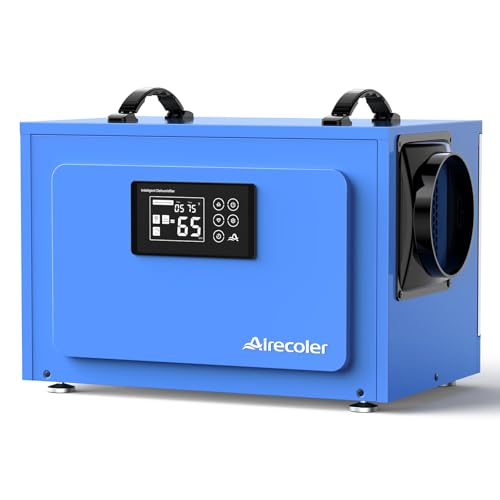
- Up to 125 pints per day at maximum capacity
- Compact design for basements and crawl spaces
- Auto drain, defrost, restart, and timer functions
Best For: Low-clearance basement and crawl-space installations
Easy Long-Run Drainage
155-Pint Dehumidifier with Pump

- Up to 155 pints per day at maximum capacity
- Built-in pump reaches up to 16.4 feet
- Energy Star certified with auto-drain features
Best For: Large basements needing flexible, unattended drainage
Restoration-Ready Mobility

- Up to 180 PPD at saturation and 85 PPD at AHAM
- Built-in pump with 19.6-foot drain hose
- Wheels, handles, auto defrost, and MERV-8 filter
Best For: Portable basement drying and water-damage restoration
Efficiency-Focused Coverage
AEOCKY 8,000-Square-Foot Model

- Up to 140 PPD under stated maximum conditions
- Rated for spaces up to 8,000 square feet
- Energy Star Most Efficient 2025 certification stated
Best For: Large basements prioritizing efficiency and capacity
Best Overall
160-Pint Basement Commercial Dehumidifier

- Up to 160 pints per day
- Built-in pump with 16.4-foot reach
- Covers spaces up to 7,000 sq. ft.
Best For: Large, heavily damp basements and commercial spaces
Best Energy Efficiency
Gasbye DryPrime Basement Dehumidifier
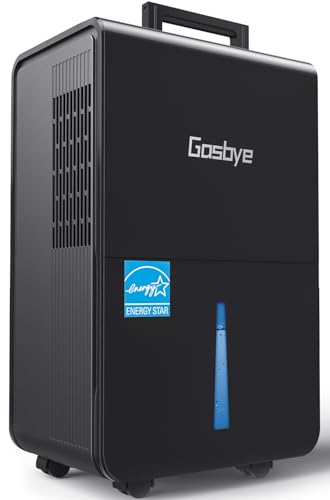
- Energy Star 2026 certified
- Runs at approximately 45 dB
- Three drainage options included
Best For: Occupied basements and garages where efficiency and quiet operation matter
Best for Crawl Spaces
Moiswell 155-Pint Compact Dehumidifier
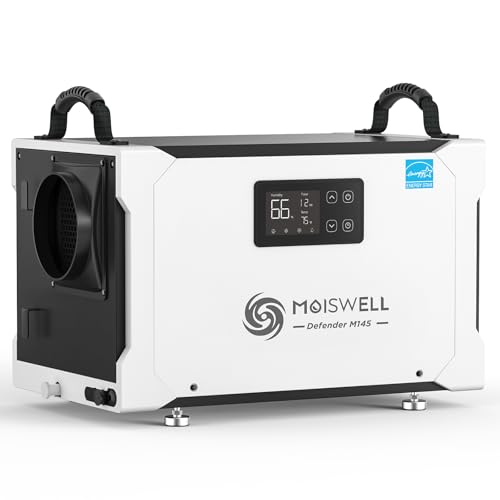
- Horizontal design fits tight spaces
- Covers up to 6,000 sq. ft.
- Five-year limited warranty
Best For: Low-clearance crawl spaces and compact basement installations
Best with Extra Features
Waykar 120-Pint Basement Dehumidifier

- Up to 120 pints per day for spaces up to 6,000 sq. ft.
- 90° auto-swing airflow and 30%–80% humidity control
- ENERGY STAR certified with continuous-drain support
Best For: Large basements and whole-home humidity control
Best Mid-Size Commercial Option
Sandidry Elite50C LGR Dehumidifier

- Up to 110 pints per day with 132 CFM airflow
- Dual RH and GPP modes for precise control
- Built-in pump, auto defrost, and 5-year limited warranty
Best For: Commercial basements and restoration work up to 1,300 sq. ft.
Best Heavy-Duty Choice
Moiswell VP320 305-Pint Dehumidifier

- Up to 305 pints per day with 412 CFM airflow
- Designed for spaces up to 8,500 sq. ft.
- 16.4-foot pump, auto-restart, and industrial mobility
Best For: Large-scale restoration, warehouses, and extreme basement moisture
Compact Drying Power – 125-Pint Basement Dehumidifier
If you need a commercial dehumidifier for basement spaces, the Airecoler GT-X5 combines substantial moisture removal with a compact footprint. It is rated for up to 125 pints per day at maximum capacity, with a 60-pint AHAM rating, and can be used in basements, crawl spaces, garages, warehouses, and other large areas.
Best For: Low-clearance basements and crawl spaces where continuous drainage, automatic operation, and flexible placement are important.
Pros:
- Compact 19.2-by-12.2-by-13.4-inch design fits tight spaces.
- Supports continuous draining with the included 6.56-foot hose.
- Includes auto defrost, auto restart, humidity control, timer, and continuous mode.
- Backed by a stated five-year warranty structure.
Cons:
- No built-in pump is listed, so gravity drainage may limit placement.
- Its 50-pound weight may make frequent repositioning inconvenient.
The GT-X5 is a practical option when space is limited but you still want commercial-grade moisture control. Its compact layout and automatic functions make it well suited to set-and-forget basement installation, provided a suitable gravity-drain route is available.
Easy Long-Run Drainage – 155-Pint Dehumidifier with Pump
The Airzentti ACD155P-PG100(B) is a commercial dehumidifier for basement areas up to a stated 7,500 square feet. It removes up to 155 pints per day under near-saturated conditions, offers a 70-pint AHAM rating, and pairs continuous operation with both gravity drainage and a built-in pump.
Best For: Large basements, crawl spaces, attics, and commercial areas where water must be moved vertically or over a longer distance.
Pros:
- Built-in pump drains water up to 16.4 feet.
- Also includes a 6.56-foot hose for gravity drainage.
- Energy Star certified and TUV compliant according to the supplied notes.
- Includes auto defrost, auto drain, screen lock, and humidity-level controls.
Cons:
- At 59 pounds and 24.3 inches wide, it is less compact than some basement units.
- The supplied airflow rating of 220 CFM is lower than some similarly rated models.
With its built-in pump and multiple drainage modes, this model reduces the installation constraints that often come with basement dehumidifiers. Its larger footprint is a reasonable tradeoff for buyers prioritizing extended, unattended operation and broad application coverage.
Restoration-Ready Mobility – Abestorm 180 PPD Dehumidifier
For demanding drying jobs, the Abestorm Hurricane 85P is a commercial dehumidifier for basement, crawl-space, garage, and water-damage applications. It is rated to remove up to 180 pints per day at saturation and 85 pints per day at AHAM conditions, with 210 CFM airflow and a built-in pump.
Best For: Water-damage restoration and basement or crawl-space projects that benefit from portable handling and long-distance drainage.
Pros:
- Built-in pump and included 19.6-foot drain hose support difficult drainage layouts.
- Wheels and built-in handles make transport easier.
- Auto defrost supports operation down to the stated 36°F minimum.
- MERV-8 filtration helps protect internal components from dust and particles.
Cons:
- The listed floor-area recommendation is 2,300 square feet, smaller than some competing models.
- The Wi-Fi panel shown in the design does not provide Wi-Fi functionality on this model.
The Hurricane 85P emphasizes portability, pump-assisted drainage, and restoration-oriented features rather than maximum whole-building coverage. It is a strong fit for moving between jobs or handling wet basement areas where a long hose and low-temperature operation are especially useful.
Efficiency-Focused Coverage – AEOCKY 8,000-Square-Foot Model
The AEOCKY RHEA-003 is designed for buyers seeking an energy-conscious commercial dehumidifier for basement and whole-home use. Its supplied notes cite a 140-pint-per-day maximum at 95°F and 95% relative humidity, plus 95 pints per day at 86°F and 80% relative humidity, with coverage listed at up to 8,000 square feet.
Best For: Large basements and homes where high moisture-removal capacity, Energy Star Most Efficient 2025 certification, and low-temperature performance are priorities.
Pros:
- Energy Star Most Efficient 2025 compressor dehumidifier certification is stated.
- Designed for spaces up to 8,000 square feet.
- Power-off memory supports automatic resumption after power restoration.
- Advanced humidity sensing and compensation are intended to improve humidity control.
Cons:
- The supplied notes do not provide full dimensions, weight, airflow, or drainage details.
- Its feature set may be more than necessary for a small basement.
This model stands out primarily for its stated efficiency credentials and large-area capacity. It is worth considering when electricity use and broad coverage matter, but shoppers should confirm installation and drainage specifications before committing to a basement setup.
Best Overall – 160-Pint Basement Commercial Dehumidifier
For demanding moisture control, this commercial dehumidifier for basement spaces combines high extraction capacity with a built-in pump. Its 265 CFM airflow and stated coverage of up to 7,000 square feet make it suited to large, persistently damp areas.
Best For: Large basements, warehouses, offices, construction sites, and other spaces that need powerful moisture removal with flexible drainage.
Pros:
- Removes up to 160 pints per day, with a stated 73-pint AHAM capacity.
- Built-in pump can move water up to 16.4 feet and includes a matching drain hose.
- Large wheels, detachable handles, automatic defrost, and continuous drainage support easier operation.
Cons:
- At 67 pounds, it is heavier than many residential units.
- Its commercial-grade capacity may be more than needed for a smaller basement.
This is the strongest choice when basement moisture is severe or drainage access is inconvenient. The pump and rugged mobility features add practical value, while the high capacity supports large-space drying.
Best Energy Efficiency – Gasbye DryPrime Basement Dehumidifier
This commercial dehumidifier for basement use is a practical fit for owners who want substantial moisture removal without overlooking operating efficiency. The Energy Star 2026 certification, quiet compressor, and automatic humidity cycling make it well suited to occupied indoor spaces.
Best For: Medium to large basements, garages, and living areas where quieter operation, flexible drainage, and energy savings matter.
Pros:
- Energy Star 2026 certified and rated up to 30% more efficient than non-certified models.
- Operates at around 45 dB for less disruption in living areas.
- Offers a 1.7-gallon tank, included hose, or 3/4-inch garden-hose drainage.
Cons:
- Its listed coverage is 4,500 square feet, less than the largest units in this roundup.
- The unit has one listed fan speed.
Choose the DryPrime when a basement dehumidifier will run regularly near family living space. Its quieter design, power-outage restart, and three drainage options make everyday use straightforward.
Best for Crawl Spaces – Moiswell 155-Pint Compact Dehumidifier
When a basement or crawl space has limited clearance, this horizontal commercial dehumidifier offers a more adaptable installation format. Its compact design can fit between floor joists or in tight areas while still providing 265 CFM airflow and substantial moisture removal.
Best For: Crawl spaces, low-clearance basements, floor- or overhead-mounted installations, and large areas needing continuous drainage.
Pros:
- Horizontal 22.5-by-14-by-14.7-inch design suits confined spaces.
- Removes up to 155 pints per day and covers areas up to 6,000 square feet.
- Includes automatic drain, defrost, shutoff, restart, humidity cycling, and a five-year limited warranty.
Cons:
- Gravity drainage requires an appropriate drain setup and does not include a built-in pump.
- At 63 pounds, installation or repositioning may require extra effort.
- The listed wattage is 860 watts, higher than the other models here.
The M145 stands out when physical fit is the primary concern. Its low-clearance-friendly shape and included automation make it a strong option for crawl spaces and tight basement layouts with a suitable gravity-drain route.
Best with Extra Features – Waykar 120-Pint Basement Dehumidifier
If you need a commercial dehumidifier for basement areas, whole homes, garages, or other spaces up to 6,000 square feet, the Waykar combines high moisture-removal capacity with flexible humidity controls. Its 90° oscillating airflow, ENERGY STAR certification, and continuous-drain option make it practical for extended operation.
Best For: Large basements and whole-home humidity control where broad airflow coverage and efficient everyday operation matter.
Pros:
- Removes up to 120 pints of moisture per day under high-humidity conditions.
- 90° auto-swing airflow helps distribute dry air more evenly.
- Adjustable 30%–80% humidity range, ENERGY STAR certification, and approximately 42 dB operation.
- Includes a 1.14-gallon tank and drain hose for manual or continuous drainage.
Cons:
- The included drain hose is only 3.3 feet long, so some installations may need a longer hose.
- Its listed coverage and capacity may be more than necessary for smaller rooms.
This is a versatile choice for buyers who want strong basement dehumidification without stepping up to a heavier restoration-focused machine. The wide humidity range and automatic protection features are especially useful for long seasonal run times.
Best Mid-Size Commercial Option – Sandidry Elite50C LGR Dehumidifier
For a commercial dehumidifier for basement use, restoration work, workshops, or storage areas, the Sandidry Elite50C emphasizes controlled, unattended operation. It offers LGR performance, dual RH and GPP modes, a built-in pump, automatic defrost, and power-failure memory in a wheeled, heavy-duty design.
Best For: Commercial basements, warehouses, construction sites, and water-damage restoration tasks requiring continuous drainage and precise humidity control.
Pros:
- Removes up to 110 pints per day in high-humidity conditions and provides 132 CFM airflow.
- RH mode adjusts from 35% to 90%, while GPP mode supports more specialized control.
- Built-in pump includes a 19.6-foot hose for upward or window drainage.
- Automatic defrost, auto humidity operation, memory function, wheels, and a 5-year limited warranty.
Cons:
- The stated maximum coverage is 1,300 square feet, smaller than the coverage of the other listed commercial models.
- Its industrial features may be unnecessary for basic residential moisture control.
The Elite50C is a focused commercial unit for jobs where reliable drainage and humidity precision matter more than maximum coverage. Its pump and memory function are helpful for unattended operation in demanding environments.
Best Heavy-Duty Choice – Moiswell VP320 305-Pint Dehumidifier
When a commercial dehumidifier for basement projects must handle severe moisture, large facilities, or time-sensitive drying, the Moiswell VP320 offers substantially higher capacity than typical basement units. Its 412 CFM airflow, built-in pump, automatic restart, and industrial mobility are aimed at restoration and large-scale commercial work.
Best For: Large basements, warehouses, factories, restoration projects, and other spaces up to 8,500 square feet where rapid, high-volume drying is required.
Pros:
- Rated for up to 305 pints per day, with a 130 PPD AHAM capacity.
- 412 CFM airflow supports spaces up to 8,500 square feet.
- Built-in pump can drain up to 16.4 feet vertically or horizontally.
- Automatic defrost, auto-restart, continuous drainage, four swivel casters, and multiple handles.
Cons:
- At 106.4 pounds, it is substantially heavier than standard residential dehumidifiers.
- Requires a 20-amp circuit and uses a NEMA 5-20 plug.
- Its 1,700-watt power draw and industrial capacity may be excessive for smaller basements.
The VP320 is the strongest option in this group for extreme humidity and rapid drying, but its electrical requirements and heavy construction should be confirmed before purchase. It makes the most sense for professional or large-facility use rather than routine room dehumidification.
How We Picked the Best Commercial Dehumidifier for Basement
We focused on models designed for large, persistently damp areas rather than occasional spot drying. The lineup includes units rated from roughly 110 to 305 pints per day, with options for basements, crawl spaces, restoration work, and expansive unfinished areas.
Our comparison emphasizes practical ownership factors: stated extraction capacity, recommended square-foot coverage, built-in pumps or gravity-drain compatibility, hose availability, portability, auto-defrost operation, humidistat controls, and energy certifications. Published capacity can vary with temperature and humidity, so treat ratings as useful comparisons—not guaranteed results in every basement.
Quick Comparison
| What to Compare | Best Fit | Why It Matters |
|---|---|---|
| 110–125 pints per day | Moderately damp basements and crawl spaces | Strong everyday moisture control without choosing the largest machine |
| 150–180 pints per day | Large or consistently wet spaces | More capacity for heavier humidity and faster drying |
| 200+ pints per day | Severe moisture, flooding, or restoration | Useful when rapid extraction is more important than compact size |
| Built-in pump | Basements without a nearby floor drain | Moves condensate upward or across the room automatically |
| Gravity drain | Units placed beside a suitable drain | Simple, quiet, and generally lower-maintenance |
Key Buying Factors for a Commercial Dehumidifier for Basement
Capacity and Actual Conditions
Choose capacity based on basement size, humidity level, temperature, and the source of moisture. A larger unit is helpful for very wet spaces, but oversizing alone will not solve groundwater intrusion, plumbing leaks, or inadequate exterior drainage.
Drainage and Pump Design
Continuous drainage is essential for unattended operation. A gravity hose works when the drain is lower than the unit. Select a built-in pump when condensate must travel upward to a sink, utility drain, or window outlet. Confirm hose length, fittings, pump lift, and whether the pump can be serviced.
Low-Temperature Operation
Basements and crawl spaces can be cool enough to cause coil frost. Auto-defrost helps the unit continue operating, but check the stated operating-temperature range if the space is unheated.
Energy Use, Noise, and Mobility
Energy Star labeling can help narrow efficient choices, while casters and handles make heavy commercial equipment easier to reposition. Review noise expectations before placing a unit near living areas, offices, or bedrooms.
Controls and Protection
Look for an adjustable humidistat, automatic restart, overflow protection, washable filters, and clear error alerts. These features reduce supervision and make long-term basement operation more dependable.
Who Should Buy Which Commercial Dehumidifier for Basement?
For a moderately damp basement: Choose a 110- to 125-pint model with continuous drainage and a humidistat.
For a large or persistently humid basement: A 150- to 180-pint unit offers additional extraction capacity, especially when the area is unfinished or poorly ventilated.
For spaces without a floor drain: Prioritize a built-in pump and verify its lift height before buying.
For flooding or restoration: Consider the highest-capacity option available, such as a 200-plus-pint model, alongside fans and a plan to correct the moisture source.
Before purchase, measure the space, identify the drain route, check outlet requirements, and confirm that the unit’s operating range suits basement temperatures. A commercial dehumidifier can control excess moisture, but sealing leaks and improving drainage remain necessary for a lasting fix.